Friday, December 2, 2011

Intestinal Parasites


Before Togo, intestinal parasites were foreign to me. Common illnesses chez moi prior to Peace Corps were mononucleosis (twice), typical winter colds (e.g. scratchy/soar throat, itchy/watery eyes, nasal congestion, etc) and seasonal allergies.
Needless to say, my body got quite the wakeup call.
My first illness wasn’t at all unfamiliar to the nurse practitioners at Peace Corps’ Medical Unit in Lomé. My insides babbled like never before. Did I mention this took place just two weeks into Training? A friend even dubbed her rambles Sigourney, referencing the leading actress in Alien. Strong yet subtle baritone notes and a roller coaster throughout the stomach and intestinal tracks are rambles worthy of such a title.
During Training, many pre-Volunteers need to become habitué'd (get used to) to living in a developing country. To this day, I blame the first round of diarrhea and vomiting to my diet in Park Slope, Brooklyn—i.e. homemade juices, fresh salads, exotic fruits, whole-wheat breads and pasta, etc. Not to scoff at Togolese food since I am quite fond of it now, however, beans and rice mixed with palm oil isn’t exactly a spinach salad lightly drizzled with walnut dressing. And no, not Snooty Samantha, it was just the grub of choice for more than a year.
Shortly after Post Visit, round two of gastrointestinal complaints commenced. I voiced my concerns to the medical officers, did my first ever stool sample, and impatiently awaited the results. It was giardiasis, an infection of the intestine with a flagellate protozoan. Boom. Yes, symptoms associated with giardia are unpleasant, however, the wicked designs left on my intestinal walls—after four tablets of Fasigyne 500 nuked these parasites—made me smile for days.
So what happened after?
After Thanksgiving, I impressively spent my weekend in bed—impressive because it isn’t an exaggeration by any means. The Monday following this weekend RESTathon I was advised by medical officers to do another M.I.F. kit and have it analyzed at Win Pang Hospital, a Chinese hospital in Dapaong.
My PCV neighbor, Maggie McRae, accompanied me to the hospital. Interesting? Picture this…two women on motos, one woman with tightly-sealed tube of her own feces in her locally-made handbag. We get there, and folks, this wasn’t my first rodeo. I’d already been to this hospital for an analysis of a different stool sample couple months ago. So I properly greeted health professionals, handed over my sample and then got a marriage proposal. Boom. If that’s not a boost of confidence, tell me what is!
Fifteen minutes later, I got the results. I have amoebas. What’s an amoeba? An amoeba is a single-celled animal that catches food and moves about by extending fingerlike projections of protoplasm. Amoebas are either free-living in damp environments or parasitic.
Surprisingly, it didn’t shock me at all. Over the weekend, I had plenty of time to review my S.H.I.T (Staying Healthy in Togo) book and thus linked my symptoms to those listed under the page-long description of amoebas.
A medical officer once again prescribed the fantastic Fasigyne 500. The kicker? This time, I had to take four tablets once a day for three days. Whoa. Okay amoebas, new ballgame!
McRae and McCullough then walked to Dapaong’s local pharmacy, bought “the goods,” parked our yovo asses on steps outside the building, sipped on a couple of Sport Actifs and greeted locals as they entered. That was fun.
The events subsequent pharmacy fun weren’t all that fun. To avoid the pity parade, I won’t go into great detail of my physical and metal state during the amoeba recovery. However, there was one moment when I graciously (and slowly) dropped from a couch at Dapaong’s PC Work Station to the floor and slowly (yep, slowly again) millimetered my way toward the bathroom.
On a positive note, I’m feeling pretty good and sent this text to McRae this afternoon:
“I’m not feeling 100 percent, but I just blared Lady Gaga and sang along. McCullough’s coming back!”

Tuesday, November 22, 2011

A Collection of Random Events: Part One

IIn all honesty, I’ve been having trouble keeping a diary in Togo. In France, I wrote all the time, everyday. In Togo, I’ve found it a challenge to write about my daily activities; 70 percent of which account for domestic chores—although slightly different from those in the US, not particularly newsworthy.

On the contrary, I’ve occasionally had random two-to-three-minute conversations with Togolese I consider to be worthy of sharing with people Stateside.

For the sake of avoiding any headaches, I’ve translated such conversations from French to English. Naturally.

EVENT NUMBER ONE:

[I’m in the market in search of a few necessities and stroll up to my regular bread vendors.]

Three female bread vendors at once: “Hello my sister! Welcome! How are you? And the trip? And the morning? And work? You want bread? Salty or sweet? 100 cfa, 100 cfa…or 200 cfa, 200 cfa.”

Me: “Hello ladies! How are you? And the night? And the morning? And the kids? And the health? And the bread?!”

I often purchase produce from various vendors, however, I rotate some regulars so they have the opportunity to see my face and get a “gift” from me from time to time.

[I ignore one vendor because I recently purchased bread from her and turn to another on her left. I ask for salty bread and pay the woman 200 cfa.

This did not sit well with the neglected vendor.

Neglected vendor: “What?!?! But I showed you my bread! Oh…you’re not nice.”

Me: “I’m not nice?! I just bought bread from you the other day. Don’t be mad. I have to buy bread from your friend today so she can profit from the white person as well.”

Today’s bread vendor: “Yeah! You ate yesterday. I will eat today. She’s nice! Everyone should have an opportunity to profit from the white person. You’re not the chief of the city!”

[We all laugh together, but the neglected woman is still pissed.]

Me: “Good work ladies. Have a nice day. Madam, over there, I’ll buy bread from you tomorrow. I promise.”

[And the neglected vendor shoots me a smile.]

Phew. That was a close one.

EVENT NUMBER TWO:

[In a restaurant with my friend Robert.]

Robert: “Your friend in village…she’s like a man.”

He’s of course referring to her short hair, her solidly built physique, her lack of wearing skirts and dresses, and the fact that she smokes.

Me: “She’s tough, for sure, but very much a woman.”

Robert: “I find it strange that she smokes.”

Me: “Oh really, why? A lot of people smoke in Togo. My friend in village doesn’t have a mini market, but people sell cigarettes, tchakpa and sodobe.”

Robert: “Yes, but have you ever seen a Togolese woman smoking a cigarette?”

Whoa.

Me: [With an inquisitive regard] “Okay. You’re right. I’ve seen several female PCVs smoking but never once have I seen a Togolese woman smoke a cigarette. That’s bizarre. Why is that?!”

Robert: “Here, in Togo, women don’t smoke because female smokers are viewed/labeled as bandits.”

Me: “What?! [I laugh out loud.] You’re joking. That’s crazy. Really?”

Robert: “Yes, it’s true. If someone sees a woman smoking, he or she believes this woman takes part in le banditisme (bandit behavior).”

Me: “Wow. Well then. I might just pass that little tidbit to my friends.”

I haven’t yet asked women how they feel about this, but I’ll slip in a question here and there to get some answers. Timing is everything, as is the women I choose to ask.

Until next time, or until A Collection of Random Events: Part Two…

Thursday, November 10, 2011

Une Petite Vacance à Kpalimé

After IST, Katy Todd (a fellow Savaner) and I were itching for a break. We itched for it probably because of a swarm of mosquitoes in Pagala. Ha! I know, I know. Bad joke. But honestly, I have enough self-control to resist the temptation to scratch a few mosquito bites. If, however, my body becomes an open bar for all mosquitoes resulting in more than 15 bites…I deem it as grounds for BLACK SWANNING. Black Swanning?? This action occurs when a person—one who has lost all self-control—scratches the bite until the bite becomes an open wound, i.e., until it bleeds. Moments like those I become quite the hypocrite for having previously slapped the hands of other Volunteers who did their own Black Swanning. My take on it: More than ten bites at one time warrants the action.

Katy and I left Atakpamé the Sunday after IST. What should have been a 45-minute taxi ride to Kpalimé was unfortunately a three-hour ride to Kpalimé. The road—or more so the rocky dirt path—we traveled on was by far the worst I’ve experienced in Togo. And once we finally reached a flat surface that resembled a paved road just shy of Kpalimé, I barely sat still with so much excitement. The cherry on the ice cream was the moment I bonded with an older gentleman—one I was actually sitting on because there were so many people crammed in the taxi. Moments before Kpalimé, the vieux lifted his right hand, extended his index finger, swiped it on my arm and showed me the dirt that once plastered my skin from the voyage. He then said with a smile, “You’re dirty.” Haha! Shall I reciprocate dear sir?

It took us approximately an hour to find a hotel room. Who knew we needed to make a hotel reservation in Togo?! (Note: Lomé and Kpalimé are probably the only two cities where it makes sense to make a reservation. Unfortunately, we missed that memo.) We stayed at Hotel Cristal for 15,000fcfa per night, which included air-conditioning, hot showers and a TV. Whoa. Living the big life!

After I showered my first hot shower in five months, I was on cloud nine. It was undoubtedly the first time I felt clean in Togo. And after my allergies flared up in Pagala, the STEAM certainly cleared those sinuses.

Among the few activities Katy and I planned for our petite vacance, the first plan of action was to dine at the Belgian restaurant called Bon Vivant. The restaurant was talked up by other Volunteers like tour guides did of the Empire State Building in NYC, so of course we had to go! Oh mon dieu. It was divine. We ordered a burger and a bottle of CHILLED red wine to toast to our three-month anniversary at post. My friends, I can’t even begin to describe the magnificence of our dining experience.

The following morning we attempted to hang-glide in small village near Kpalimé, but alas, time was an issue. We didn’t have it.

On the contrary, we had time to shop! We also took motos to the top of a mountain for some fresh air to see waterfalls and the remarkable view.

Bottom photo: I bought a couple paintings in a small village on top of a mountain and the artist said only natural materials are used. (See photo.)

Overall, it was a lovely break from Training and Dapaong. At the same time, both Katy and I couldn’t wait to get back home. Traveling in the U.S. is exhausting, but traveling in Togo…there are no words.

I think Lonely Planet wrote it best:

“…getting around without your own transport requires the patience of a saint and the determination of a fighter.”

Yeah… K

In-Service Training in Pagala

In-Service Training, or IST for the acronym inclined, is required of all PCVs; and it occurs three months after moving to post. IST is located in Pagala, southeast corner of the Centrale region. What’s it like there? Ever been to summer camp? It’s precisely that, well, that plus several technical sessions in French, a bit of Togolese food mixed with faux-American food, an empty pool, and lots of mosquitoes. Volunteers shared rooms together (two to one room) in cabins similar to those I often found in Michigan—minus the beautiful lakeside view.

We ate every single meal together in a dining hall and we also rendezvoused for a café break twice a day for five days. Whoa, I know. We often divided into our designated programs (CHAP and SED) to review information relevant to our goals and objectives. CHAP Trainers, for instance, informed PCVs on latrine projects, how to train health workers, how to give proper health talks to young adults, and the malaria campaign in Togo. Needless to say, it was tiresome for new PCVs to go from a laidback schedule to one that resembled a bit like boot camp—sans intense physical activities.

For the most part, the week in Pagala was pleasant. I ate well—probably, no most definitely, ate too much. I played games (ping-pong, Frisbee, chess, volleyball (with a soccer ball) and basketball); I watched a movie (X-Men: First Class…a bit disappointing); and on the last day of IST we all dressed up and celebrated Halloween together.

After just five months with PC Togo, I learned to appreciate one pivotal fact: The experience is what you make of it. Yes, PCVs have several guidelines to follow throughout service. Yes, PCVs often share ideas with one another and dive into cross-sector collaboration. These statements are very true, but also it is the responsibility of the Volunteer to assess the needs of his or her community. For me, it’s nutrition, hygiene and sanitation. It was nice to receive positive remarks on my project ideas from other Volunteers and Trainers during IST. Encouragement. Encouragement. Encouragement!

So, what’s my plan?

  • Set up a stand in my market and educate the community on basic nutrition.
  • Perfect the recipe for moringa juice and work with young adult groupements who may be able to prepare and sell the juice for a profit. (IGA: income generating activity.)
  • Attend sporting events every Saturday at Collège Saint Anthanese and do health talks on nutrition with young students.

What will I need to succeed?

  • Time
  • Preparation
  • A Moba translator
  • Proper materials
  • Money (I will most likely be obliged to pay for my spot at the market)

I think this plan is pretty realistic and applicable to the needs of my community. I just need to remind myself to have patience.

On verra.

Oh…and I just couldn’t resist a photo of this snail I saw in Pagala. I’ve seen so many in Togo I had to capture one! Always reminds me of The Bucket List:

Jack Nicholson on Buddhism:

“What does a snail have to do to reincarnate? Leave a perfect trail of slime?!”

Monday, October 17, 2011

CFA, CFA!


In France, I remember my fellow foreigners and I held onto one and two euro coins like miners who found gold nuggets deep in Earth’s core. Notes, or bills, were easy to find but the larger the note the greater the task of ridding oneself of it. At the time this seemed partial to Western Europe since prior to my study abroad experience paying a $30 bill with $100 wasn't arduous. 

By the end of the scholastic year, we were jaded by our small-coin collection. It was inconceivable banks mass-produced one, two and five-cent coins. In nine months, these coins accumulated in a jar at the bottom corner of my bedroom’s armoire. 

Once, shortly before I departed the worthless-small-coin-infested country, I went to a brasserie with a friend and ordered my usual hot chocolate—drinking coffee preceded studying abroad. When the server brought the bill to the table on a small plastic saucer, I knew it was either now or never. The opportunity presented itself to be free of this nuisance. I paid my portion of bill with only one, two and five cent coins and bolted out of the brasserie as if I stole cutlery or left without paying. Really, what was I going to do with those coins in the US? Start a coin collection? America already had enough hoarders and I figured the act was also karmic retribution for France’s superior customer service. America undoubtedly takes the cake on customer service. It occurred to me much later to return all small coins to a bank in exchange for larger bills. 

In China, it was the exact opposite. I wanted those insignificant coins. Shit, I needed all coins!! One thing I knew for certain: China and France make it difficult to pay a small bill with a larger note. Between the two, France was definitely the lesser of two evils—at least France accepted torn or faded notes. In Shanghai, one morning after my friends and I celebrated life, we dragged ourselves to a restaurant and bought a few sandwiches to hopefully cure our hangovers. An hour or so later it was time to pay the bill and leave, but I had a 100RMB note. Grâce à dieu, the server had no qualms about breaking the note; well, at least not my roommate’s 100RMB note. Such was not the case for me. He told me he couldn’t accept mine. Confused and agitated, I immediately analyzed the note, checked to see if it was counterfeited, and concluded it was fine. The server protested and after several minutes he finally exclaimed he couldn’t accept it because the upper-right corner of the note had a pimple-size piece missing. This infuriated me. But what could I do? Hang out at the restaurant all day? The server insisted I walk to a bank to exchange the “bad” note for a “good” one. I obliged and walked approximately 50 yards to the nearest bank, found an open teller and after he exchanged the bill I asked him straightforwardly, “Where does the ‘bad’ money go?” The teller said there is a shop that specializes in repairing notes. Of course there is! How silly of me!
Monetarily, Togo is France and China in one.

In the beginning, I thought Togo had it right. The coins I used daily—e.g. twenty-five, fifty, one hundred, two hundred and five hundred—were practical. Tout à coup, a vendor gave me 50 cents worth of 10-cent coins. THERE IT IS! The piece of France I had forgotten. And it didn’t end there. Not even a week passed before someone handed me a five-cent coin. Come on!!!

Oh but it didn’t even end there. The last couple of months I received water and electric bills with unusual figures: water for 3,295cfa and electricity for 12,060cfa. Really??? It’s not as though I’m stateside where I could easily write a check for such amounts. Because of this, I either lost or gained five or 10 francs with each bill. Brilliant.

When it comes to money and traveling in Togo, it is important to remember two phrases:
“100 francs, 100 francs.”
“On va chercher la monnaie.”

The former is a phrase often said by vendors. In markets, women who sell fruits and vegetables often place them into small piles and when a customer asks the price, they say the number twice. Almost always.
The latter is a phrase said by everyone, i.e. vendors, motorcycle taxi drivers, Togolese friends, etc. Unlike in China, if one can’t break change in Togo…the person will find someone who will. Boom. One point to Togo.

Thursday, October 6, 2011

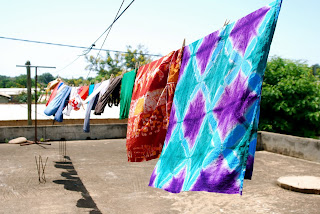
Laundry Day

In France, hand washing included three articles of clothing: underwear, bras and socks. My French host mom once informed me the washing machine chez nous “n’était pas si bon.” Translation: “It wasn’t very good,” thus wouldn’t properly clean our delicates. Quelle surprise! Hand washing undergarments wasn’t a draining task by any means, just dated. Most women are familiar with hand washing bras with underwire, but add panties and multiple pairs of socks and it becomes more of a workout than a chore.

In Togo, laundry day isn’t just a five-minute exercise; it’s P90X or Bikram Yoga!!! I’m half naked while I hand wash my clothes. Why? It’s NOT because I don’t have any clothes to wear, NOR is it because I left my sweats in a friend’s hut, BUT it is because I’m dripping with sweat!!! This morning, I consciously shorten my cardio and Pilates’ workout because of laundry day.

Got questions? Well these may or may not be your questions, but it’s a start. Et voila

What do you need to hand wash in Togo?

  • Three buckets: one large bucket for washing, one small bucket for rinsing, and one bucket (of a similar size) for damp, clean clothes.

  • One bar of fabric-safe soap

  • Powdered laundry detergent (probably made in China)

  • Water (Not just for clothes, but for hydrating)

  • A clothesline, one or more

  • Clothespins (beaucoup)

  • TIME

  • ENERGY

  • MUSCLES


What are my two least favorite items to wash?

  • Patagonia blue jeans—best jeans I own, but so heavy!
  • Bed sheets (I actually don’t wash these anymore. I can’t be bothered with it and I’d rather pay 1,000cfa for a professional to wash my sheets. And by professional, I mean a Togolese teenage girl.)

Do I separate whites from colors?

Bien sûr! Moreover, I separate my American clothes from my Togolese clothes—pagnes bleed like crazy!

How long does it take?

It really depends on how much I have (duh) and the clothes I need to wash. If, for instance, I don’t need to wash my lovely Patagonia blue jeans, it doesn’t take long at all. More often than not, it takes me about 90 minutes. Then of course the remaining work (e.g. drying clothes) is left to the sun.

How long did it take me to do my laundry the first time?

THREE HOURS!!!!! I guzzled down two Sport Actifs—a Togolese version of Gatorade—after that three-hour fuckshow. My 18-year-old host brother even came to my rescue me at the end. Ugh. I felt so inadequate.

All things considered, I quite enjoy hand washing my clothes. Enjoyment generally follows completion of such a task. Whenever I am deep in hand-washing mode, I often repeat “TOGO…I WILL TRIUMPH!”

And once I’ve finished, I sit in front of my fan and read.

Boom. Done. J

Saturday, October 1, 2011

Rubbish 101

As a child, I didn’t think twice about trash. Scraps for which I no longer found a use were chucked in a bin and that was all she wrote. I don’t even recall when the term landfill entered my vocabulary, let alone the thought of landfill sites filled to capacity due to over consumption and high-waste accumulation.

The presidential election in 2004 was the first time I heard prospective candidates mention climate change and important political movements needed to protect the environment. Environmental projects were without a doubt on the back burner of presidential campaigns at the time—just enough talk to attract environmentalists, conservationists and tree huggers. That was then, and this is now.

By 2009, most US universities invested in a plethora of large recycling bins throughout campuses, provided reusable cutlery and biodegradable plates in cafeterias, and campaigned to urge students to conserve water by avoiding the use of food trays. Wow. As a wannabe environmentalist, the pride oozed from my pores when I witnessed such a campaign. After I moved to New York City, it wasn’t long before my sister Kathrine and her waste-conscientious friends had a positive impact on my environmental beliefs.

In my apartment in Brooklyn, I often noticed more items in recycling bins than trash bins. Moreover, composting had become an excuse to go into the city. Yes it was a little less than desirable to lug a couple of Envirosax reusable bags filled with banana peels, coffee grounds, tea bags, etc in the subway. The pungent odor, however, weakened when I walked through Union Square, passed hot apple cider and fruit-filled muffin vendors, and found one of NYC’s community composts. I’d be lying if I said I didn’t feel virtuous after I dumped food scraps in those compost bins.

In Togo, trash has entirely new meaning; and I certainly wasn’t prepared for the change. All I knew before I arrived in Togo was consumption was going to decrease, and waste would also decline. Togolese embrace the phrase one person’s trash is another person’s treasure. But it doesn’t end there. Almost everything is reused. In fact, I can tell when a bottle of Sport Actif has recently been washed, cleaned, relabeled and filled with more Sport Actif by the top line from the liquid—a bit of residue I suppose. I’ve even picked up a habit of tearing off labels from bottles for not only my amusement, but also to help speed up the recycling process. Yeah!

Remember the phrase mothers and fathers always tell their children if food is left on their plates? “Hey! There are starving children in Asia and Africa!” Well Volunteers have practically tattooed such a phrase on their hearts. Honestly, if a Volunteer wastes food in Africa…whoa…sure hope they’re praying to whatever God they think will help them. Any unwanted food—leftovers unable to preserve—is simply passed to petits (little children) in the area. They’ll find somebody who’ll eat it if not themselves and our consciences are cleared.

I don’t have a special compost procedure similar to Brooklyn, but it’s something: place banana peels, carrot and spinach stems, egg shells, etc in a plastic bag and whenever I go for a walk around town or run errands I just toss scraps in nearby fields. All part of the circle of life!!

Tomato paste and tuna cans are reused—either as Dutch oven pieces or muffin pans and candleholders. Whatever water bottles I have chez moi have been reused as cooking oil and kerosene containers; and Togolese often use empty gin bottles as petrol containers.

What about everything else? Tissues, phone and Internet cards, Tampons and pads L, etc are all burned. Yes, burned. Truth is, this is my least favorite part about being in Togo. I despise burning trash. After hearing stories of female Volunteers who had not properly burned their trash and then found children playing with used Tampons, I not only make sure I burn my trash early in the morning, but I soak that S#*T with kerosene. Burn baby, burn!!

What about restaurants and other businesses? What do they do with their trash? They burn their trash too! And as mentioned above, one person’s trash is another person’s treasure. There’s no shame in it either. Just reusing what is available, adding a bit of creativity, and reducing waste. Nice.

À la prochaine! J