Monday, October 17, 2011

CFA, CFA!


In France, I remember my fellow foreigners and I held onto one and two euro coins like miners who found gold nuggets deep in Earth’s core. Notes, or bills, were easy to find but the larger the note the greater the task of ridding oneself of it. At the time this seemed partial to Western Europe since prior to my study abroad experience paying a $30 bill with $100 wasn't arduous. 

By the end of the scholastic year, we were jaded by our small-coin collection. It was inconceivable banks mass-produced one, two and five-cent coins. In nine months, these coins accumulated in a jar at the bottom corner of my bedroom’s armoire. 

Once, shortly before I departed the worthless-small-coin-infested country, I went to a brasserie with a friend and ordered my usual hot chocolate—drinking coffee preceded studying abroad. When the server brought the bill to the table on a small plastic saucer, I knew it was either now or never. The opportunity presented itself to be free of this nuisance. I paid my portion of bill with only one, two and five cent coins and bolted out of the brasserie as if I stole cutlery or left without paying. Really, what was I going to do with those coins in the US? Start a coin collection? America already had enough hoarders and I figured the act was also karmic retribution for France’s superior customer service. America undoubtedly takes the cake on customer service. It occurred to me much later to return all small coins to a bank in exchange for larger bills. 

In China, it was the exact opposite. I wanted those insignificant coins. Shit, I needed all coins!! One thing I knew for certain: China and France make it difficult to pay a small bill with a larger note. Between the two, France was definitely the lesser of two evils—at least France accepted torn or faded notes. In Shanghai, one morning after my friends and I celebrated life, we dragged ourselves to a restaurant and bought a few sandwiches to hopefully cure our hangovers. An hour or so later it was time to pay the bill and leave, but I had a 100RMB note. Grâce à dieu, the server had no qualms about breaking the note; well, at least not my roommate’s 100RMB note. Such was not the case for me. He told me he couldn’t accept mine. Confused and agitated, I immediately analyzed the note, checked to see if it was counterfeited, and concluded it was fine. The server protested and after several minutes he finally exclaimed he couldn’t accept it because the upper-right corner of the note had a pimple-size piece missing. This infuriated me. But what could I do? Hang out at the restaurant all day? The server insisted I walk to a bank to exchange the “bad” note for a “good” one. I obliged and walked approximately 50 yards to the nearest bank, found an open teller and after he exchanged the bill I asked him straightforwardly, “Where does the ‘bad’ money go?” The teller said there is a shop that specializes in repairing notes. Of course there is! How silly of me!
Monetarily, Togo is France and China in one.

In the beginning, I thought Togo had it right. The coins I used daily—e.g. twenty-five, fifty, one hundred, two hundred and five hundred—were practical. Tout à coup, a vendor gave me 50 cents worth of 10-cent coins. THERE IT IS! The piece of France I had forgotten. And it didn’t end there. Not even a week passed before someone handed me a five-cent coin. Come on!!!

Oh but it didn’t even end there. The last couple of months I received water and electric bills with unusual figures: water for 3,295cfa and electricity for 12,060cfa. Really??? It’s not as though I’m stateside where I could easily write a check for such amounts. Because of this, I either lost or gained five or 10 francs with each bill. Brilliant.

When it comes to money and traveling in Togo, it is important to remember two phrases:
“100 francs, 100 francs.”
“On va chercher la monnaie.”

The former is a phrase often said by vendors. In markets, women who sell fruits and vegetables often place them into small piles and when a customer asks the price, they say the number twice. Almost always.
The latter is a phrase said by everyone, i.e. vendors, motorcycle taxi drivers, Togolese friends, etc. Unlike in China, if one can’t break change in Togo…the person will find someone who will. Boom. One point to Togo.

Thursday, October 6, 2011

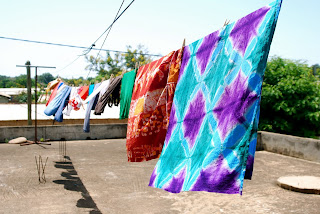
Laundry Day

In France, hand washing included three articles of clothing: underwear, bras and socks. My French host mom once informed me the washing machine chez nous “n’était pas si bon.” Translation: “It wasn’t very good,” thus wouldn’t properly clean our delicates. Quelle surprise! Hand washing undergarments wasn’t a draining task by any means, just dated. Most women are familiar with hand washing bras with underwire, but add panties and multiple pairs of socks and it becomes more of a workout than a chore.

In Togo, laundry day isn’t just a five-minute exercise; it’s P90X or Bikram Yoga!!! I’m half naked while I hand wash my clothes. Why? It’s NOT because I don’t have any clothes to wear, NOR is it because I left my sweats in a friend’s hut, BUT it is because I’m dripping with sweat!!! This morning, I consciously shorten my cardio and Pilates’ workout because of laundry day.

Got questions? Well these may or may not be your questions, but it’s a start. Et voila…

What do you need to hand wash in Togo?

  • Three buckets: one large bucket for washing, one small bucket for rinsing, and one bucket (of a similar size) for damp, clean clothes.

  • One bar of fabric-safe soap

  • Powdered laundry detergent (probably made in China)

  • Water (Not just for clothes, but for hydrating)

  • A clothesline, one or more

  • Clothespins (beaucoup)

  • TIME

  • ENERGY

  • MUSCLES


What are my two least favorite items to wash?

  • Patagonia blue jeans—best jeans I own, but so heavy!
  • Bed sheets (I actually don’t wash these anymore. I can’t be bothered with it and I’d rather pay 1,000cfa for a professional to wash my sheets. And by professional, I mean a Togolese teenage girl.)

Do I separate whites from colors?

Bien sûr! Moreover, I separate my American clothes from my Togolese clothes—pagnes bleed like crazy!

How long does it take?

It really depends on how much I have (duh) and the clothes I need to wash. If, for instance, I don’t need to wash my lovely Patagonia blue jeans, it doesn’t take long at all. More often than not, it takes me about 90 minutes. Then of course the remaining work (e.g. drying clothes) is left to the sun.

How long did it take me to do my laundry the first time?

THREE HOURS!!!!! I guzzled down two Sport Actifs—a Togolese version of Gatorade—after that three-hour fuckshow. My 18-year-old host brother even came to my rescue me at the end. Ugh. I felt so inadequate.

All things considered, I quite enjoy hand washing my clothes. Enjoyment generally follows completion of such a task. Whenever I am deep in hand-washing mode, I often repeat “TOGO…I WILL TRIUMPH!”

And once I’ve finished, I sit in front of my fan and read.

Boom. Done. J

Saturday, October 1, 2011

Rubbish 101

As a child, I didn’t think twice about trash. Scraps for which I no longer found a use were chucked in a bin and that was all she wrote. I don’t even recall when the term landfill entered my vocabulary, let alone the thought of landfill sites filled to capacity due to over consumption and high-waste accumulation.

The presidential election in 2004 was the first time I heard prospective candidates mention climate change and important political movements needed to protect the environment. Environmental projects were without a doubt on the back burner of presidential campaigns at the time—just enough talk to attract environmentalists, conservationists and tree huggers. That was then, and this is now.

By 2009, most US universities invested in a plethora of large recycling bins throughout campuses, provided reusable cutlery and biodegradable plates in cafeterias, and campaigned to urge students to conserve water by avoiding the use of food trays. Wow. As a wannabe environmentalist, the pride oozed from my pores when I witnessed such a campaign. After I moved to New York City, it wasn’t long before my sister Kathrine and her waste-conscientious friends had a positive impact on my environmental beliefs.

In my apartment in Brooklyn, I often noticed more items in recycling bins than trash bins. Moreover, composting had become an excuse to go into the city. Yes it was a little less than desirable to lug a couple of Envirosax reusable bags filled with banana peels, coffee grounds, tea bags, etc in the subway. The pungent odor, however, weakened when I walked through Union Square, passed hot apple cider and fruit-filled muffin vendors, and found one of NYC’s community composts. I’d be lying if I said I didn’t feel virtuous after I dumped food scraps in those compost bins.

In Togo, trash has entirely new meaning; and I certainly wasn’t prepared for the change. All I knew before I arrived in Togo was consumption was going to decrease, and waste would also decline. Togolese embrace the phrase one person’s trash is another person’s treasure. But it doesn’t end there. Almost everything is reused. In fact, I can tell when a bottle of Sport Actif has recently been washed, cleaned, relabeled and filled with more Sport Actif by the top line from the liquid—a bit of residue I suppose. I’ve even picked up a habit of tearing off labels from bottles for not only my amusement, but also to help speed up the recycling process. Yeah!

Remember the phrase mothers and fathers always tell their children if food is left on their plates? “Hey! There are starving children in Asia and Africa!” Well Volunteers have practically tattooed such a phrase on their hearts. Honestly, if a Volunteer wastes food in Africa…whoa…sure hope they’re praying to whatever God they think will help them. Any unwanted food—leftovers unable to preserve—is simply passed to petits (little children) in the area. They’ll find somebody who’ll eat it if not themselves and our consciences are cleared.

I don’t have a special compost procedure similar to Brooklyn, but it’s something: place banana peels, carrot and spinach stems, egg shells, etc in a plastic bag and whenever I go for a walk around town or run errands I just toss scraps in nearby fields. All part of the circle of life!!

Tomato paste and tuna cans are reused—either as Dutch oven pieces or muffin pans and candleholders. Whatever water bottles I have chez moi have been reused as cooking oil and kerosene containers; and Togolese often use empty gin bottles as petrol containers.

What about everything else? Tissues, phone and Internet cards, Tampons and pads L, etc are all burned. Yes, burned. Truth is, this is my least favorite part about being in Togo. I despise burning trash. After hearing stories of female Volunteers who had not properly burned their trash and then found children playing with used Tampons, I not only make sure I burn my trash early in the morning, but I soak that S#*T with kerosene. Burn baby, burn!!

What about restaurants and other businesses? What do they do with their trash? They burn their trash too! And as mentioned above, one person’s trash is another person’s treasure. There’s no shame in it either. Just reusing what is available, adding a bit of creativity, and reducing waste. Nice.

À la prochaine! J

Saturday, September 24, 2011

Celebrating 25 Years Togo Style

On September 20, Dapaong cut its electricity—frequently occurs whenever a frightful storm is en route or a scalding Savannah day. Needless to say with all my electronic on the brink of death, I was concerned. Surely if I was able to survive two months without running water or electricity in Gbatopé, I should deem two days of no electricity as a walk in the park. True, however, this did occur just two days before my 25th birthday. Bit of a pickle, right? My anxiety increased with every passing hour for how could I possibly toast to a quarter of my life without a Lady Gaga song? Although I am eager for a new Gaga album, Bad Romance will forever remain number one in my iPod’s Top 25 Most Played list. (Shortly before we headed to begin the celebration, John Barlow—a fellow Savanner and my neighbor—said with great spirit, “Alright, let’s get this party started.” And then he played Bad Romance from his computer. People already know me too well.)

At 8:37pm on September 21, I laid in bed, crossed my fingers and toes, and prayed to the Gods—quite the sucker for Greek and Roman mythology—for the return of electricity on my birthday. At 1:07am, I heard the single click from my voltage regulator and another click from my fan and boom…the power was on. After approximately thirty seconds, just enough time to sing the Happy Birthday song out loud, I got up and charged everything (e.g. cell phone, computer and iPod). It was a race for power!

At 2:30am, the power cut again. The light sleeper I am woke up to this immediately and said, “Togo, what the @&#&?!?!?! A teaser? Not nice, not nice at all.” Though incredibly irritating, I had enough charge time to semi-recharge my cell phone and plenty of power for a couple hours of quality party tunes.

Since my fridge was kaput, I had to scrap my phenomenal cherry-flavored Jello and fresh pineapple birthday treat. Though bummed, I found something even better: Oatmeal cake. Now, there is something I must include in this entry, which is the complete and utter failure of Samantha Grace McCullough making three desserts in Togo. The first two desserts were actually the same one. It was a Volunteer’s birthday and I made a yellow cake. Surprisingly there was enough batter for two pans (two cakes). I burned the first one, half an inch thick. Was a little sad, but reminded myself of the extra batter. Awesome, I just won’t tell people I messed up the first one. In my world, there was only one cake, the right one. I decided to bake batch #2 at a lower temperature and SOMEHOW still managed to burn it as well!! With great frustration, I placed one of the lesser-burnt cakes in a Ziploc bag for the birthday boy and concluded opening a bottle of substandard red wine as the best idea I had the entire night. The third dessert was a batch of oatmeal cookies. It was an utter disaster, which involved a lot of dishes, a messy kitchen, several burnt fingers and a pile of vanilla-flavored mush.

This of course had to change. I surely wasn’t going to leave Togo without making a successful dessert. My friend Katy argued once that I made good brownies not too long ago. She often forgets it was a TEAM EFFORT. She helped…a lot. No, this was a battle and I was going to win on my birthday, damn it.

Sticking to my cooking norms, I followed the directions with a bit of tweaking, i.e., vanilla extract, dried cranberries with raisins and fresh pineapple. I assembled my Dutch oven and once again prayed to the Gods. Unable to contain my excitement, I checked the progress of the cake EVERY 10 MINUTES. After every glance, I grew more and more psyched! It was going to work!! I sensed it. And holy balls my friends, BEST DESSERT I HAVE MADE IN MY LIFE. Oh yeah and to top, it was on my birthday.

The cake was a success but it wasn’t over. The butter in my fridge was about to go bad. Aaaahh! Crap. What do I do?! I can’t waste food in Africa—sure ticket to H*E*double hockey sticks. I frantically flipped through the frosting section of my recipe book and found Never Fail Fudge Frosting. Boom. Done. The fudge frosting (like the dried cranberries) was a brilliant idea. All was right with the world minus lack of electricity.

Afterwards, I did the dishes, cleaned house a bit, and decided to repose by reading my latest book, How to Shit in the Woods by Kathleen Meyer. Another Volunteer sent this to me and after having read A Civil Action, it was time for a bit of humor. As soon as I came across a section on Giardiasis, the power returned! YES! Once again plugged everything back in and jammed to Katy Perry while I took a refreshing cold shower. I washed my curls with Devashan products, put clips in my hair, wrapped a pagne around me and popped a squat in front of my fan. Niiiiiiiiice.

The night festivities entailed playing ping pong (without a table), drinking a couple of calabashes of Tchakpa (locally-made beer in Savannah Togo) and dining at Campement. Campement is one of only a couple restaurants Volunteers deem worthy of a birthday celebration. This is true in part because of its privacy and in part because of its delicious food, both western and African. Katy and I ate Cordon Bleu, and shared green beans and mashed potatoes. Never underestimate the power of mashed potatoes, garlic and butter!! John ate steak with mashed potatoes and Maggie chose French Onion soup…wuss. It was amazing.

We did a few other things: Planned a Captain Planet movie (see photo) and I fell into the massive ditch near Campement and scrapped my knee. Awesome. Everyone had a good laugh including yours truly. “Very entertaining. My favorite part was when the moto driver quickly turned on his lights and shined them on you,” Katy said.

Pretty successful birthday I must say.

A bientot. J

Wednesday, September 14, 2011

Mefloquine Mondays

According to the Programme National de Lutte contre le Paludisme, the arm of the Togolese government that manages national malaria programs, malaria is the number one cause of death in Togo.

What is malaria? Malaria is a vector-borne parasitic disease with global distribution. Malaria parasites are vector-transmitted by the female Anopheles mosquitoes. The parasites multiply within liver cells and also within red blood cells. Malaria symptoms often include fever, chills, nausea, headache, flu-like illness, diarrhea, vomiting, anorexia, cirrhosis, spleen enlargement, anemia (including light headedness, shortness of breath, and tachycardia) and in severe cases, coma and death.

Whoa.

Before we, as Trainees, hit our 24th hour in Togo, PC Med Unit instructed us to take two pills at the same time: Doxycycline (Doxy) and Mefloquine (Mef). Mef is the best prophylactic drug currently available, but takes a full week to work its way through the human body. Doxy is a commonly prescribed prophylactic and begins working immediately. This, in short, is the reason medical officers instructed us to consume both pills at the same time the first day, and for the following six days we only took Doxy. Doxy must be taken daily whereas Mef is only once per week. After reading the list of symptoms in my Community Health and AIDS Prevention Toolkit, ingesting one pill a week to avoid malaria seemed like a no-brainer.

The kicker, of course, is side effects associated with Mef. Some people experience vivid, physically stimulating dreams, and some experience frightening nightmares. I regret neither the former or nor the latter are side effects I have acquired while taking Mef. Sure, it seems peculiar to want spine-chilling dreams. Well, in truth, I don’t want those dreams. I want the vivid sex dreams I keep hearing about from other Volunteers. I believe it to simply be a little cadeau for two years of service. Right? Asking too much? Unfortunately, instead of a bit of sensual pleasure, I get the other side effects--lame ones such as hair loss, irritability, anxiety and the jitters.

It really isn’t too unpleasant. The hair loss bit kind of blows, but people often experience hair loss with something as simple as a change of diet or climate. Thankfully, I only experience the jitters on Mef Mondays. It certainly isn’t painful, however, I do feel as though I’ve consumed five cans of Red Bull in one hour. (Note: This is a mild exaggeration and only lasts a day.)

As you might expect, the thought of popping one prophylactic drug a week doesn’t appeal to me. At the same time, malaria is right up there with blister beetle burns as things I don’t want while in Togo.

So…Mef Mondays it is my friends! If any readers have any Mef or Doxy stories they are willing to share, feel free to comment.

Sunday, September 4, 2011

Taxi-Brouse…When Motos are Forbidden


For the most part, Volunteers in Togo take great pleasure in riding motorcycles. Unfortunately, along with other Peace Corps laws, Volunteers are forbidden not only to drive to "motos" but also to ride on La Rue Nationale (national road). Along with riding motos sans casque (without helmet), riding a moto on La Rue Nationale also warrants administrative separation. Voila…la taxi-brouse.
Contrary to motos, a taxi-brouse, or shuttle, is a thorn in a Volunteer’s side. At least, that’s the word on the street. These shuttles—most just one cataclysmic storm away from a junkyard—are a Volunteer’s primary means of transportation from north to south and vice versa. Imagine if you will a caravan with no air-conditioning, cement seats with a thin vinyl covering, and approximately 10 to 15 passengers crammed in a nine-passenger vehicle. Voici la taxi-brouse.
Short journeys in a taxi-brouse are tolerable. Trips from Lomé to Dapaong (or anywhere in Savannah Togo) are almost unbearable. For Post Visit, myself and four other Trainees did the trip in approximately 14 hours. A week later, we briefed our Trainers on our taxi-brouse experience and recommended the trip be divided into two days. At 6a.m., the morning after we were sworn-in as Volunteers, we embarked for our two-day trip up north. Thank you for listening PC Trainers!
How could it have possibly been a 14-hour trip from Lomé to Dapaong? What’s the size of Togo again?
Togo is approximately 87 miles east to west and 317 miles north to south. It’s approximately 400 miles to travel from Petoskey, my hometown in Michigan, to Ferndale (near Detroit) and takes about four hours to drive.
Hmmmm…400 miles versus 317 miles, and four hours versus 14 hours…What?! How?!
The answer is infrastructure. The further you travel up north, the worse La Rue Nationale gets. It’s quite a problem in Togo. The road is too narrow for two vehicles traveling in opposite directions and it has many large potholes. The reason it takes so long to travel from south to north is inconsistent momentum. Drivers must slow down before rolling over potholes because the tires can’t handle it. Tire flats in northern Togo are as common as mosquito bites in southern Togo. Sure, there are a few other reasons: pit stops for food, buying gifts for friends and family members, and bathroom breaks (men don’t have to walk far from the car).
There’s a bit of a joke among Volunteers that Savaners (that’s me) are loners who don’t travel south to visit other Volunteers, their friends. Well, that’s not entirely true. Savannah is a tight cluster!! We aren’t loners up north. But honestly, can you blame us?! First, make the trip…then, tell the joke my friends.
After writing the blog entry on motos, I asked one of my closest neighbors to write a true story about a taxi-brouse experience. Since Volunteers in Togo are far from anonymous, I’ll throw my friend a bone and refrain from disclosing her name. Here’s her story:
After walking up a hill in the 80-degree heat with a black dog in tow that maintained his “guardian” reputation by snapping at the heels of any petits (little children) who came too close, I found a group of men sitting under a tree with a cluster of multi-toned cars with bald tires parked nearby. I figured these were the taxi-brouse drivers. I didn’t see anyone holding a calabash or drinking out of a plastic bleach bottle, so I also deduced (along with the fact that it was only 10a.m.) that they were at least sober. At that point, anyway. Hopefully. I told them I wanted to go to Nano, which is actually pronounced more like Nanu and they told me that they weren’t going there. I asked if I should wait for more passengers, and they shrugged and told me sure.
After a few minutes of stressing on the phone, I decided I might as well go for it and rent out an entire car. I asked the drivers how much it would cost to go about 40 km with me and the dog, and one muttered “quatre-vingt…” No, I’m not paying 80 milles francs to take a dog to a place where he’s probably just going to get eaten anyway. Eight milles francs one-way was the final offer, even though apparently people have done it for five, which of course included the trip back.
In the car, the dog instantly began to sniff the driver and attempt to crawl out his window. Meanwhile, I’m tugging on the leash, cursing at the dog, and smiling at the driver assuring him that the dog is nice, and no he does not bite. The dog then continued to be over-stimulated and crawl around my lap with his long nails digging into my stomach and thighs. I ended up grabbing his collar to keep him still while the driver swerved around the potholes whenever he could, or at least make sure it was the passenger side that went over them when it was absolutely necessary. The bald tires held up, though, and it took about an hour to get to Nano/u.
After an awkward conversation where I tried (for the third time) to tell the driver that I’m taking other means of transit back to Dapaong, I ventured off with another Volunteer. The dog trotted along on his leash as I brushed his short, fine, black hairs off of my chest. Then a man came up and offered to marry me.
T.I.A. (This Is Africa)

Saturday, August 27, 2011

Motos, Moto Riding and Moto Drivers

At the conclusion of June 2009, I classified my international internship in Shanghai as advantageous, fulfilling and money well spent. I enjoyed the Shanghainese cuisine, the Shanghai Business Review magazine, the people, and the city. After having arrived at Detroit Metropolitan Airport, I had one regret: Neither finding the time, nor having the cojones to ride a moto.

As luck would have it, instead of a lifetime of regret, I only needed to wait two years for satisfaction. Thank you Togo!

Even before PC Togo Introductions in Lomé, it was common knowledge that all-terrain bicycles are given to Volunteers for city/village transport. What didn’t I know? Evidently, grâce à Togolese infrastructure (or lack there of), Togo is one of only a few countries where moto helmets are also provided. Score! During Training, in addition to bike mechanics 101, my fellow Trainees and I got the lowdown on motoing in Togo—oh yeah, motoing is a word—and each Trainee received his or her helmet to decorate and keep throughout service.

So I suppose la question du jour is do I or don’t I enjoy riding motos? I FREAKING ADORE RIDING MOTOS. Just like my personality blossoms in a megalopolis, my body was built for motoing!

Basic moto must-dos:

· Wear your helmet—otherwise you’ll be administratively separated from PC.

· Negotiate fare before mounting moto.

· DO NOT wrap your arms around moto drivers—they aren’t your boyfriends and will probably assume you want a Togolese husband.

· Always mount a moto from the left (like a bicycle)—if not, beware of moto muffler!

· If you decide to wear a skirt or dress, hike it up and wrap a pagne (piece of fabric) around your legs.

· DOUCEMENT: Learn it, Live it, Love it. Doucement, meaning slowly or be careful in Togo, is very useful and comprehensible to all Togolese.

· Make sure the driver isn’t intoxicated—no matter if they are Muslim.

· If you have a monster daypack, hand it to the driver. There’s no extra praise for Volunteers who carry heavy packs on their backs if unnecessary.

It may simply be an adrenaline rush, but I get such a kick out of motoing in Togo. I may even go as far as rating it a highlight to any day in Dapaong. Perhaps it’s a combination of speed, wind blowing threw visor, dodging potholes, dodging other motos with goats and mattresses tied to the back. It’s all very riveting. Frankly, the moto stories are right up there with diarrhea stories on the awesome-o-meter.

A couple of days ago, after several hours of deep cleaning the PCV Work Station in Dapaong, four dog-tired PCVs grabbed some refreshments at Robinet, a local bar. We talked about the Midwest, NYC, California, Americanisms, Togoisms, life in Savannah; we ate spiced tofu; and we did what Togolese do best…reposed. After an hour or so, I had to moto back chez moi to drop off a few items and pick up my bike. On the road, just outside the bar, I saw two guys chilling on motos. Without hesitation, I walked over to one and asked if he knew Bar Escale—a bar close to my house. With a faint voice, he said “Oui” and nodded his head. I replied, “Bon, on peut aller pour 300?” (Good, we can go for 300CFA?) He confirmed and then told me I was going to ride his friend’s moto. I checked out his friend—a slow, up and down scan—and suspected he was more intoxicated than I preferred for a moto driver. I turned back and shook my head no. It didn’t take him long to realize I wasn’t mounting his friend’s moto. So I hopped on his moto and he drove very well. Once I descended the moto in front of Bar Escale, I took off my helmet, smiled and said, “Voila, 300.” My new moto friend replied, “Oh, I’m not a taxi. It’s free.”

Um…What?!?!?! Why didn’t you tell me Dude?

I felt like such a jackass. Sure, it was awesome because I got a free trip home, but sucked because I felt like an idiot. Ah well, he didn’t seem to be bothered by it. Togolese are pretty nice, must admit.